What is ambient scenting?

Businesses may intentionally scent shared air to mask odors, create atmosphere, influence behavior, or reinforce brand memory.

This week, you may encounter it in a business—without advance notice or access to information about the product or chemicals released.

  • Hotels + Resorts
  • Airports
  • Retail
  • Gyms + Spas
  • Medical Facilities
  • Offices
  • Apartment Lobbies
  • Restrooms
  • Theaters + Venues
  • Transportation
  • Other Shared Interiors
Illustration representing signature scenting in a commercial interior.
Behind the branding, a “signature scent” means intentionally introducing fragranced or scented substances into shared air.

How does it work?

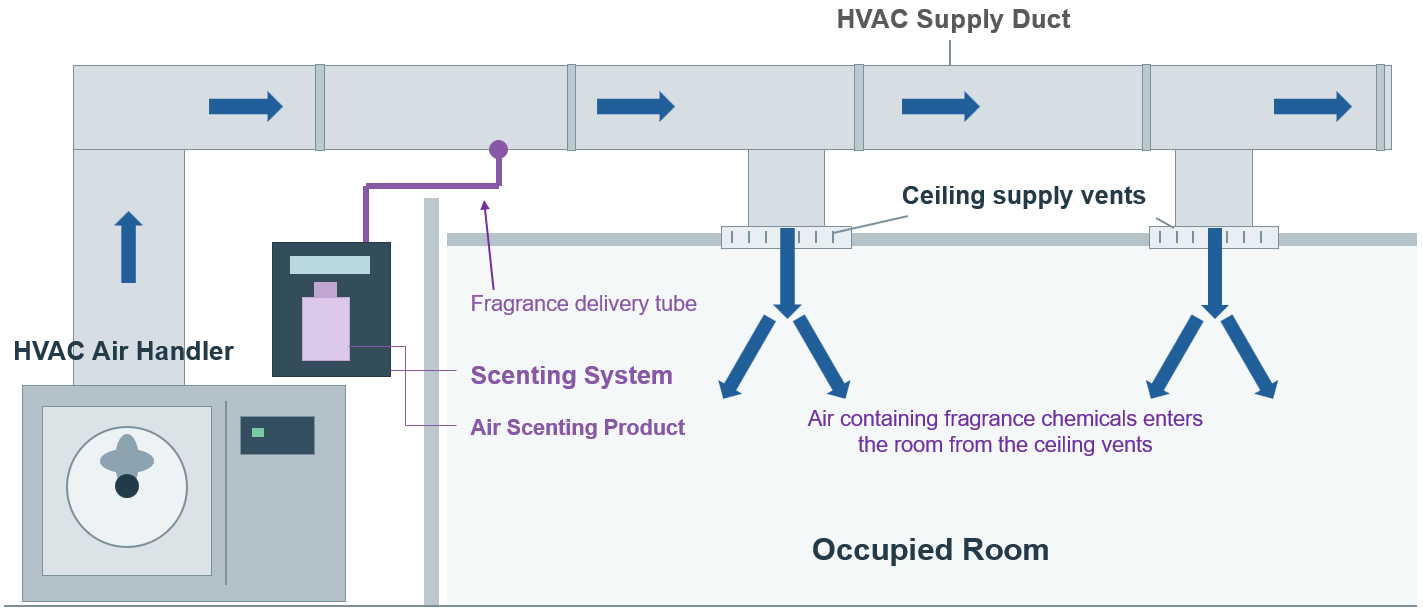
A device disperses fragrance chemicals directly or through a building’s airflow.

1

A scent is selected.

A stock or custom scent blend may contain fragrance ingredients and other chemicals. Formulas are often proprietary.1

2

A device disperses it.

HVAC systems, nebulizers, and timed or sensor-controlled sprays disperse fragrance or scent into shared air, often out of view.

3

It enters shared air.

VOCs can reach adjoining spaces and settle on surfaces.

4

Occupants breathe it.

People may be exposed before they know their air is scented.
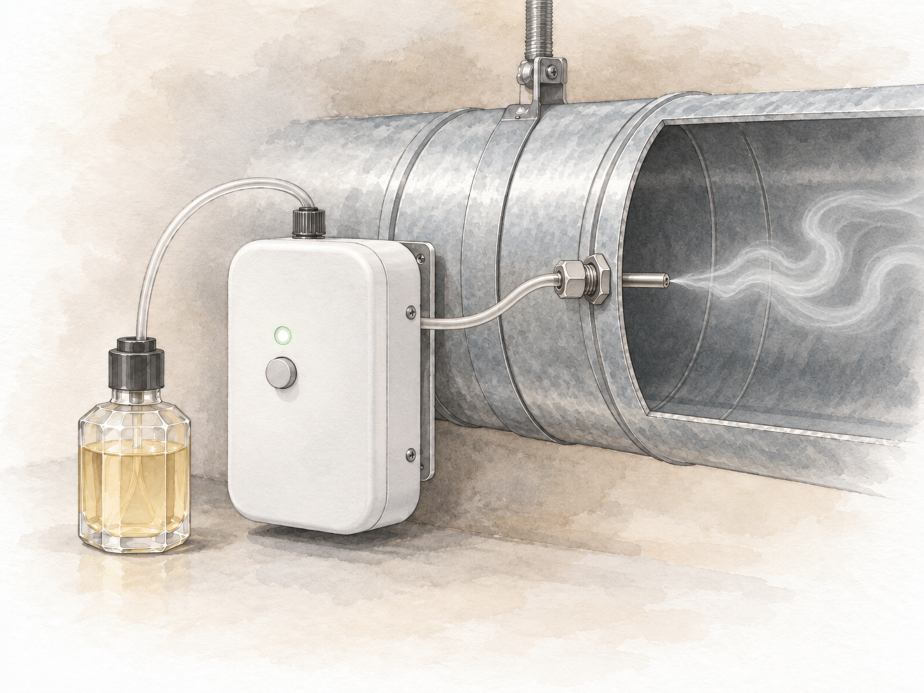
HVAC-connected scent delivery equipment.

HVAC-Integrated Systems

Uses building airflow to scent multiple rooms or zones.

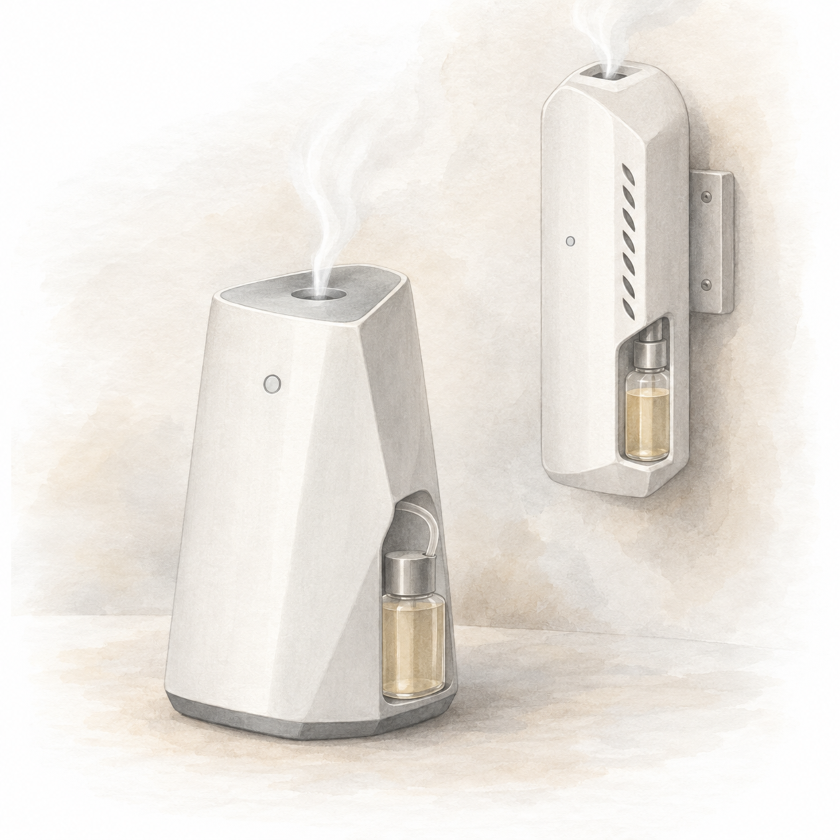
Standalone fragrance diffuser used for localized ambient scenting.

Stand-Alone Diffusers

Devices scent lobbies, restrooms, treatment rooms, retail areas, or other zones.
Automatic aerosol dispenser used to release fragrance at intervals.

Automatic Aerosol Dispensers

Scheduled fragrance or scent release, by sensor, or at preset intervals—often in restrooms or odor-control areas.

Key Point

Ambient scenting changes shared air for everyone. Visitors may encounter fragrance or scent unexpectedly; workers may be exposed for hours.

History of Scent Marketing

Has scent marketing outpaced regulation?

1930s Scent studied

Researchers test scent as a consumer cue.2

1970s Atmospherics

Research suggests retail atmosphere can influence purchasing decisions.3

1990s Scent branding

Casinos, resorts, and retailers adopt signature scents.

2000s Hospitality

Hotels use scent to shape guest experience and extend brands into amenities.

mid-2000s Influence

A field study finds that product-matched scent can affect shopper behavior. 4

2010s Sensory branding

Scent is linked with memory, mood, product evaluation, and dwell time.5

2011+ Exposure concerns

Studies find VOC emissions;6 surveys report fragrance-related health effects.7

2020s Widespread, less visible

Many brands now disperse scent in shared indoor and outdoor spaces.8

2026 ADA litigation

Class-action lawsuits filed alleging violations of ADA and state consumer-protection laws.9

The Question Businesses Ask

Don’t marketing studies show customers prefer scent?

Marketing studies and population health surveys ask different questions. Both matter.

What marketing studies measure:

Mood, memory, and purchasing behavior among people who remain in the scented space; those who leave or avoid it may not be captured in the data.

“Some customers liked it” “Everyone can safely breathe it”

Even a pleasant scent is still an intentionally added shared-air exposure.

What population surveys find:

35% Of surveyed U.S. adults report health effects from fragranced products.7
20% Would enter and leave a business as quickly as possible if they smell fragrance.7
48–65% Preferred fragrance-free airplanes, hotels, health-care facilities, or workplaces.10
Cost-Benefit Analysis

Weigh possible benefits against consumer avoidance, prolonged worker exposure, access barriers, and legal risk.

Many complaints are never made

Why don’t businesses hear more fragrance complaints?

Quiet Avoidance

People may simply leave, avoid a restroom, or go elsewhere.

Too Unwell

Headache, nausea, or breathing symptoms shift attention to escape and recovery.

Hidden Source

People may not connect symptoms to a hidden scent-delivery system.

Employees

Workers may stay silent because of stigma, privacy, or fear of consequences.

Survey Results

About 9% of adults reported fragrance-related lost work or job loss in the prior year—rising to ~21% among asthmatic and ~59% among autistic respondents.11

Why It Matters

Ambient scenting changes indoor air chemistry.

Indoor air quality is affected by contaminant sources and ventilation.12 Scenting adds an avoidable source.

Intentionally added.

Scenting deliberately adds emissions to shared air.

Extended exposure.

Workers and other occupants may be exposed to fragrance and scenting emissions for hours.

Odor masking.

Scent masks odors, but the moisture, waste, ventilation, or cleaning problem may persist.

Ambient Scenting Disclosure Gap

Basic questions about fragrance and scented air often go unanswered.

People should know what is dispersed, where, and how to avoid it. Often, they do not.

  • Is fragrance or scent being dispersed? Many people find out only after entering.
  • What product is used? Its name, supplier, and safety information may not be posted.
  • Where? One system may affect a lobby, restroom, common area, or multiple zones.
Illustration suggesting fragrance being dispersed into shared indoor air
  • How often? And for how long? Timers, sensors, intensity settings, and service schedules may be undisclosed.
  • What is in it? Formula ingredients may be protected as trade secrets.1
  • Who can opt out? Customers can leave; workers, tenants, patients, and visitors may have little control.
Right to Know

People should know before entering that fragrance or scent is intentionally added to shared air.

Projected global scent marketing market growth.

Why Act Now

Scent marketing is growing.

Industry estimates vary but consistently project growth.13,14

As ambient scenting spreads, one question becomes urgent: should businesses add fragrance or scent to shared air without notice, product information, or fragrance-free alternatives?

Sample Notice Concept

What fair notice could say

NOTICE: Fragrance or scent is dispersed in this area. Airborne exposure may occur, and some emissions can react to form secondary pollutants.15 Scan the QR code or ask for product and safety information.
  • Post notice. Identify the system, scented area, product, supplier, and safety information.
  • Protect access. Provide fragrance- and scent-free routes, rooms, restrooms, and accommodation procedures.

Clean Air is the True Luxury

A cleaner alternative

  • Make clean air part of the brand.
  • Remove odor sources. Fix moisture, trash, drains, ventilation, and cleaning at the source.
  • Choose fragrance-free soaps, cleaners, laundry products, and restroom supplies—and avoid products or devices intended to add scent to shared air.
Next: See who already chooses clean air

References

Certain percentages shown on the page above are rounded to the nearest whole number. Exact values from each study appear in the references below.

  1. U.S. Food and Drug Administration (FDA). "Fragrances in Cosmetics." Accessed August 2026. (Safety Requirements) The FDA requires ingredient lists on consumer cosmetics under the Fair Packaging and Labeling Act, but that law cannot force disclosure of trade secrets. Fragrance and flavor formulas — complex mixtures of many chemicals — qualify as trade secrets, so they may be listed simply as “Fragrance” or “Flavor” instead of itemized.
  2. Krishna, A. (2012). "An integrative review of sensory marketing: Engaging the senses to affect perception, judgment and behavior." Journal of Consumer Psychology, 22, 332–351. https://doi.org/10.1016/j.jcps.2011.08.003 Reviews sensory-marketing research, including relationships between smell and memory, product and store evaluations, and consumer search behavior; also discusses Laird’s 1932 consumer-smell study.
  3. Kotler, P. (Winter 1973-1974). “Atmospherics as a Marketing Tool.” Journal of Retailing, Vol. 49, No. 4. "One of the most significant features of the total product is the place where it is bought or consumed. In some cases, the place, more specifically the atmosphere of the place, is more influential than the product itself in the purchase decision. In some cases, the atmosphere is the primary product."
  4. Spangenberg, E. R., et al. (2006). "Gender-Congruent Ambient Scent Influences on Approach and Avoidance Behaviors in a Retail Store." Journal of Business Research, 59(12), 1281–1287. https://doi.org/10.1016/j.jbusres.2006.08.006 A field experiment in an actual retail store. A “gender-congruent” ambient scent is one whose culturally perceived gender matches the gender associated with the products on sale — here, a scent most people rated as masculine (rose maroc) diffused over men’s merchandise, and one rated as feminine (vanilla) over women’s. When the scent matched the products this way, shoppers evaluated the store and merchandise more positively and bought more; when the scents were swapped (incongruent), that benefit disappeared. These gender associations are learned and culturally specific, not inherent to the scents.
  5. Roschk, H., & Hosseinpour, M. (2020). “Pleasant Ambient Scents: A Meta-Analysis of Customer Responses and Situational Contingencies.” Journal of Marketing, 84(1), 125–145. https://doi.org/10.1177/0022242919881137 Supports claims about customer-response effects of pleasant ambient scent and the importance of context and situational contingencies.
  6. Potera, C. (2011). “Indoor Air Quality: Scented Products Emit a Bouquet of VOCs.” Environmental Health Perspectives, 119(1), A16. https://doi.org/10.1289/ehp.119-a16. PMID: 21196139; PMCID: PMC3018511. "A survey of selected scented consumer goods showed the products emitted more than 100 volatile organic compounds (VOCs), including some that are classified as toxic or hazardous by federal laws.1 Even products advertised as “green,” “natural,” or “organic” emitted as many hazardous chemicals as standard ones." Article summarizes the work of Steinemann AC, et al. "Fragranced consumer products: chemicals emitted, ingredients unlisted." Environ Impact Assess Rev. doi: 10.1016/j.eiar.2010.08.002.
  7. Steinemann, A. (2016). “Fragranced consumer products: exposures and effects from emissions.” Air Quality, Atmosphere & Health. Supports that 34.7% of U.S. adults surveyed reported adverse health effects from exposure to fragranced consumer products.
  8. Reports of major brands using scent marketing; hotels diffusing custom lobby scents, airports adopting signature scents, and transit spaces using fragrance as advertising or passenger-experience design. These examples illustrate the breadth of shared air scenting practices. Sources note: Articles above report about scenting practices or campaigns, and are not claims that any named location currently uses scenting or that the practice is unlawful.
  9. Cole & Van Note, Attorneys at Law. "Fragrance Investigations, Recent Filings." Accessed July 2, 2026.
    Holland & Knight. “Wave of Fragrance Class Actions Targets Hospitality Industry.” Holland & Knight Alert, June 15, 2026. Reports that multiple class action suits have been filed alleging ADA and state consumer-protection violations.
  10. Steinemann, A. (2019). "Ten questions concerning fragrance-free policies and indoor environments." Building and Environment, 159, 106054. https://doi.org/10.1016/j.buildenv.2019.03.052
  11. Steinemann, A. (2021). "The Fragranced Products Phenomenon: Air Quality and Health, Science and Policy." Air Quality, Atmosphere & Health, 14, 235–243. https://doi.org/10.1007/s11869-020-00928-1 Survey results indicate that among the general population across four countries surveyed, 9.0% of adults had lost workdays or lost a job, in the previous year, due to illness from exposure to fragranced products in the workplace. This percentage increases for asthmatics to 20.6%, and to 59.4% for autistic individuals. Notes that regulatory protections allow fragrance ingredients to go undisclosed.
  12. Occupational Safety and Health Administration (OSHA). "Indoor Air Quality." Accessed August 2026. "Many factors affect IAQ. These factors include poor ventilation (lack of outside air), problems controlling temperature, high or low humidity, recent remodeling, and other activities in or near a building that can affect the fresh air coming into the building. Sometimes, specific contaminants like dust from construction or renovation, mold, cleaning supplies, pesticides, or other airborne chemicals (including small amounts of chemicals released as a gas over time) may cause poor IAQ."
  13. Verified Market Reports (market research estimates). "Global Scent Market Size, Industry Share, Trends & Forecast 2026-2033." Accessed July 1, 2026.
  14. Business Research Insights. “Scent Marketing Market Size, Share, Growth, and Industry Analysis.” Commercial market-research estimate; updated July 20, 2026. Accessed August 9, 2026. Market estimates vary by provider and market definition.
  15. Horvat, T., Pehnec, G., & Jakovljević, I. (2025). "Volatile Organic Compounds in Indoor Air: Sampling, Determination, Sources, Health Risk, and Regulatory Insights." Toxics, 13, Article 344. https://doi.org/10.3390/toxics13050344. Open access under a Creative Commons Attribution license. "Monoterpenes readily undergo chemical reactions with airborne oxidative agents, such as OH•, NO3, or ozone, producing dangerous secondary pollutants such as organic acids, formaldehyde, and SOA [129]." (p. 14 of 36) "Terpenes are used as active solvents in some cleaning products and perfumed agents in consumer products. These substances produce formaldehyde, hydrogen peroxide, hydroxyl radical and SOA in reaction with ozone [185–187]. According to Bello et al. [188], ten-minute cleaning sessions with glass and bathroom cleaners raised overall VOC concentrations for up to 20 min after the cleaning operation ended. Singer et al. [189] investigated concentrations of limonene and showed that it can be found in 10 to hundreds of milligrams per cubic meter in air and persist for many hours after cleaning." (p. 22 of 36) "Indoor air ventilation systems can significantly affect air quality. Several studies have highlighted increased levels of VOC concentrations in areas with inadequate ventilation." (p. 22 of 36)
  16. California Air Resources Board (CARB). "Fragrance Use in Consumer Products." Accessed August 2026.
  17. California Legislature. California Cleaning Product Right to Know Act of 2017 (SB 258). California’s Cleaning Product Right to Know Act of 2017, enacted by SB 258 and later clarified by AB 2901, requires ingredient disclosure for covered cleaning and air-care products sold in California, including intentionally added fragrance ingredients that appear on designated hazard or allergen lists; the remaining fragrance-formula components may still be withheld as confidential business information.